What Actually Drives Dumpster Rental Cost in Plymouth
No two dumpster jobs price the same. Here are the real factors behind a flat-rate quote — size, tonnage, rental length and material — so you know what to describe when you call.
Plymouth dumpster guide
Five roll-off sizes, one simple rule for picking between them — matched to the projects Plymouth and South Shore homeowners actually run.
Every call about dumpster size starts the same way: someone describes a project and asks for a number. The honest answer is that the number depends less on how big the job feels and more on what the material actually weighs. A roll-off fills up two ways — by volume and by weight — and whichever one runs out first sets your limit. Light, bulky debris like furniture, framing offcuts and household clutter fills the box before it gets heavy. Dense material like concrete, shingles, tile or wet soil hits its weight allowance while the container still looks half empty. Getting that distinction right is most of what “the right size” means.
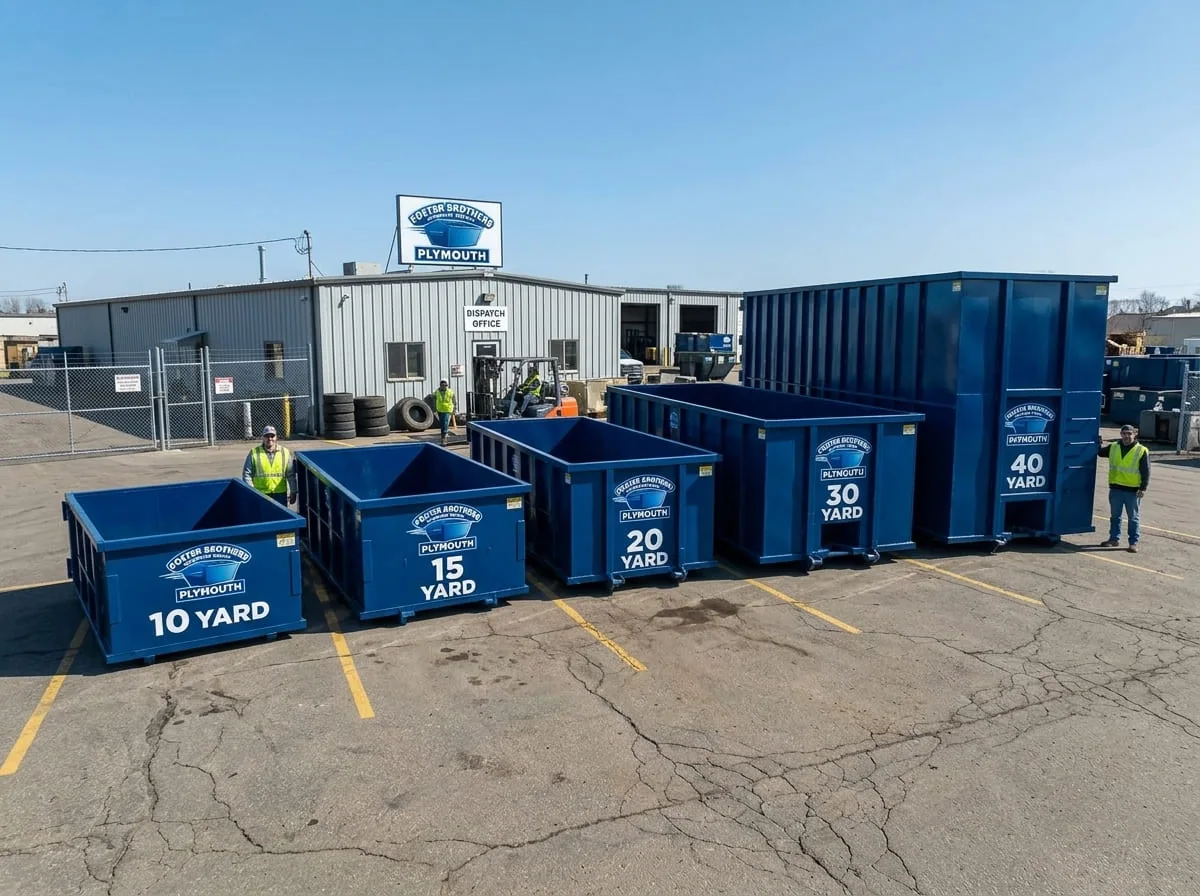
Foster Brothers Dumpster Rental runs five roll-off sizes across Plymouth and the South Shore — a 10, 15, 20, 30 and 40 yard. Here is what each one actually is, and the kind of project it tends to fit.
Roughly 12 ft long × 8 ft wide × 3.5 ft high, holding about 3 pickup truck loads with a 1–2 ton weight allowance. The low sides and small footprint make it the specialist container for dense material rather than a “small job” box. A single room of concrete, brick or tile removal, a bathroom strip-out, soil from a landscaping project, or a small single-layer roof tear-off (up to around 15 squares) will typically use up its tonnage well before its volume. It is also the easiest size to fit on a tight or shared Plymouth driveway. See the 10 yard dumpster page for the full specs.
About 16 ft long × 8 ft wide × 4 ft high, roughly 4–5 pickup loads and a 2–3 ton allowance. A 10 yard is often tight for a full attic or garage cleanout, and a 20 is more container than a single kitchen remodel needs — the 15 sits in between. It handles attic and garage cleanouts, cabinetry coming out of a kitchen or bath, a medium roof tear-off, or a small deck removal without paying for space you never fill. Details are on the 15 yard dumpster page.
Around 22 ft long × 7.5 ft wide × 4.5 ft high, about 6 pickup loads, with a 3–4 ton allowance. This is the size most Plymouth-area jobs land on by default, and it is a reasonable one to start a phone call with if you are not sure yet. Whole-home decluttering, a larger roof tear-off, drywall and finish debris from a renovation, or a full estate contents clear-out generally fit well here. It is also often the smarter choice over a 30 for anything with real weight in it — a 20 yard filled with plaster, tile or a two-layer tear-off will hit its tonnage long before a 30 yard's volume runs out, so the bigger box just means paying for air. See the 20 yard dumpster page.
About 22 ft long × 8 ft wide × 6 ft high, roughly 9 pickup loads, 4–5 tons included. This is the volume container: full home renovations, new construction phases, whole-house estate clearances, and multi-family turnovers where the material is bulky rather than dense — furniture, cabinetry, packaging, insulation, framing offcuts. The same caution applies in reverse here: if your load is mostly concrete, brick or shingles, a smaller size with a matched tonnage allowance is usually the better value. Details on the 30 yard dumpster page.
Roughly 22 ft long × 8 ft wide × 8 ft high, about 12 pickup loads, 5–6 tons included. This is the size for large commercial fit-outs, sizeable demolition or renovation projects, and high-volume light debris where a 30 would need multiple swaps. It needs real clearance to place and is rarely the right call for an ordinary residential job — for most homes, a 20 or 30 will do the same work for less. See the 40 yard dumpster page for the full breakdown.
A quick way to think about it: a single-room cleanout or anything genuinely heavy (concrete, brick, dirt, tile) usually points to a 10 or 15 yard. A whole-home cleanout, roofing job, or renovation phase usually points to a 20 yard. A full renovation, new build, or estate cleanout with a lot of bulky contents usually points to a 30 yard. Commercial and large-scale demolition debris jobs are where a 40 yard earns its size. If a project mixes both — say, a kitchen gut that includes tile demo and cabinetry — describe both parts when you call and we will size for whichever runs out first.
Plymouth and much of the South Shore sit on a glacial outwash plain, which generally means sandy, well-drained soil that handles a parked roll-off fine on a normal driveway. The one thing worth watching is the edges: a full container is heavy, and loose or sandy shoulders can rut or erode a bit under the weight, particularly on properties near a pond, bog or other low-lying ground where the water table runs higher, especially in wetter seasons. Pointing this out when you book — and picking a firm section of the driveway for placement — avoids any surprises.
Weight is what actually decides most sizing questions, not how big the pile looks. Describe the project when you call and we will size it honestly, including telling you when the smaller container is the right answer. See the full lineup on the dumpster sizes page, browse services for the type of job you are running, or contact us for a flat-rate quote. If cost is the main question on your mind, our guide to what actually drives dumpster rental cost covers that in detail.
FAQs
The 20 yard is the default most homeowners land on — it handles whole-home cleanouts, larger roof tear-offs and renovation debris without needing a large footprint. If you are unsure, it is a reasonable size to start the conversation with when you call.
Not proportionally. Each size carries its own tonnage allowance, and doubling the volume does not double the included weight. A larger container packed with dense material like concrete or shingles can hit its weight limit long before it looks full, so matching material type to size matters as much as matching project size.
Plan on roughly 20 feet of length for a 10 or 15 yard and about 27 feet for a 20, 30 or 40, plus around 10 feet of width so the doors can swing open. The delivery truck separately needs a fairly straight approach and enough overhead clearance, so low branches and wires matter as much as the pad itself.
Ready when you are
Call and you will speak to someone local who knows the streets, the permit rules and which box actually fits your driveway. Flat rate quoted up front.
Keep reading
No two dumpster jobs price the same. Here are the real factors behind a flat-rate quote — size, tonnage, rental length and material — so you know what to describe when you call.
Most household, construction and yard debris is fine — but Massachusetts has a few state-specific rules worth knowing before you load, starting with electronics.
It mostly comes down to where the container sits. Here's the difference between driveway placement and street placement in Plymouth — and who actually regulates it.